


An international team of researchers has identified an East African bat coronavirus capable of entering human cells.
Whilst the virus - Cardioderma cor coronavirus (CcCoV) KY43, or CcCoV-KY43 - can bind to a cell receptor found in the human lung, preliminary testing in Kenya suggests it has not spilled over into the local human population.
Rather than work on ‘live’ viruses, the scientists used a public database of known genetic sequences, Genbank, to select and synthesise alphacoronavirus ‘spike’ proteins, including 27 viruses originally isolated in bats, and screened these against a library of coronavirus receptors found in human cells.
Spike proteins protrude from the surface of coronaviruses, including SARS-CoV-2, and bind to specific receptors on human cells, triggering infection.
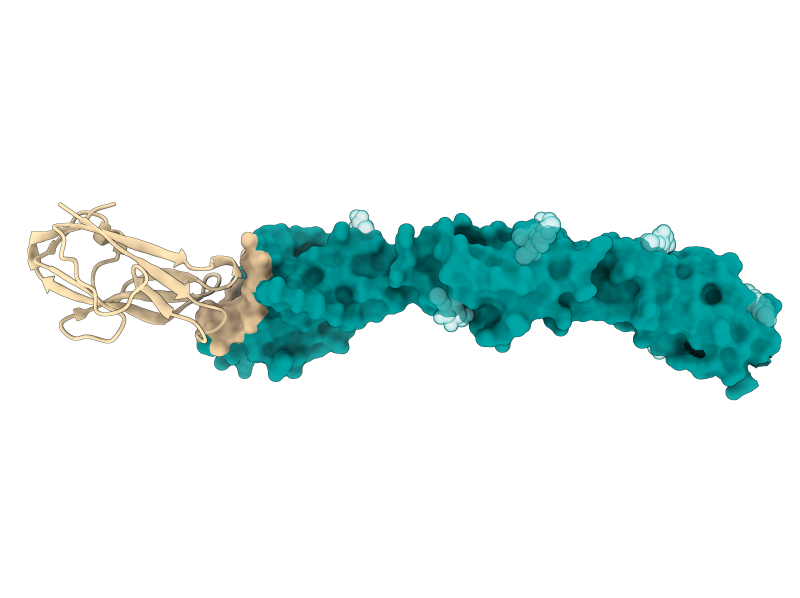
Figure shows alphaCov spike (light brown) binding with the human cell surface protein CEACAM6 (cyan).
Funded largely through UK Research and Innovation’s Biotechnology and Biological Sciences Research Council (BBSRC), and Kenya Government’s National Research Fund (NRF), the study brought together UK and Kenyan expertise to show CcCoV-KY43 can bind to the human glycoprotein CEACAM6.
Writing in the journal Nature, the team from The Pirbright Institute, the University of Cambridge, the KEMRI-Wellcome Trust Research Programme, the University of York and the National Museums of Kenya say their findings show alphacoronaviruses (alphaCovs) can use various receptors to enter human cells.
Dr Dalan Bailey, Group Leader at The Pirbright Institute, said:
“Before our study, it was assumed most alphacoronaviruses used just one or two possible receptors to enter their host, and the only difference was which species they could enter. We now know alphaCovs might use a whole variety of additional receptors to get into cells.”
Stephen Graham, Professor of Virus: Host Interactions at the University of Cambridge, said: “Viral spike proteins are keys that fit into locks (host receptors) to open the door and enter a cell. So far, we have identified one alphaCov receptor. The challenge now is to find the others.”
Dr Giulia Gallo, a viral glycoproteins specialist and lead author, said: “Not only did we find the new coronavirus receptor in human cells ahead of any virus spillover into the human population, but the study was performed using just a piece of the virus (the spike) rather than the whole pathogen, negating the need to import a live virus into the UK.”