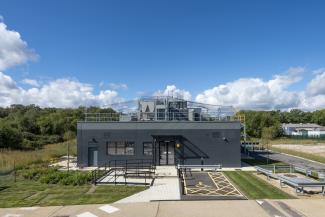
Front of the building

The Pirbright Institute

We are a world-leading centre of excellence in the research and surveillance of viral diseases of livestock and viruses that spread from animals to humans. 

Four black and white cows grazing on lush green grass. The sky is bright blue with fluffy white clouds.

Protecting the UK

Our facilities provide a National Capability and are unique within the UK with a complement of scientific expertise and physical resources.

Statement

Bluetongue testing

Pirbright carries out BTV testing on behalf of APHA and Defra, which is currently taking up to 10 working days. If disease confirmation is required, results will take longer. Pirbright can only confirm results once the testing process is complete. We ask those submitting test samples to ensure the form is completed correctly, checked before it is sealed, and that the parcel is clearly identified as ERZ, WRZ or Pre-licence move before it is sent. Please do not contact the laboratory directly. We cannot provide results over the phone or by email. For queries regarding test results, please contact APHA on 03000 200 301.

Researcher in white lab coat and purple gloved hands pipetting into an eppendorf tube

Ourscience

Our innovative fundamental and applied bioscience contributes to global food security and health, improving quality of life for animals and people.

Two people stood having a discussion amongst wildflowers

Engage with us

Collaborate with us to access our facilities and explore our training courses delivered by our experts in science, engineering and biosafety.

The Plowright Building

Facilities and resources

Discover our specialist science facilities, including unique high-containment laboratories, advanced technology platforms, and access our services and products like diagnostic testing.

Latest news

Preventing and controlling viral diseases

Viruses we study

Our research focuses on viruses that are potentially devastating for the economy, food security and the wellbeing of animals and humans.

Transmission electron microscope image shows SARS-CoV-2, the virus that causes COVID-19. Crown-like spikes on the outer edge of the virus particles give coronaviruses their name.

Latest research