


When diseases like sheep pox and goat pox sweep through small ruminant herds, the impact is immediate and profound - affecting household income, food security, and the ability to recover from financial shocks.
For many farmers in northern Nigeria, these losses aren’t just numbers on a spreadsheet; they shape the rhythm of daily life.
A new mobile application, SR-DISVAXFIC, developed through a collaboration between The Pirbright Institute and the National Veterinary Research Institute (NVRI) in Nigeria, is helping change that reality. The app translates complex epidemiological models - grounded in real conditions on Nigerian farms - into practical, real-time insights at farm level.
The original models were created and designed by Dr Megan E. Rawlins as part of her MSc project, delivered in partnership with the Royal Veterinary College. Building on this work, the app was later developed and supported through The Pirbright Institute’s Impact Acceleration Account call.
For Dr Georgina Limon Vega, Project Lead and Group Leader of Applied Epidemiology at The Pirbright Institute, the motivation behind the app was straightforward:
“We wanted to create something people in the field could actually use.”
Dr Adeyinka Adedeji, Principal Veterinary Research Officer, and the team at NVRI tested the app in the field, working directly with farmers to make sure it was relevant and accessible.
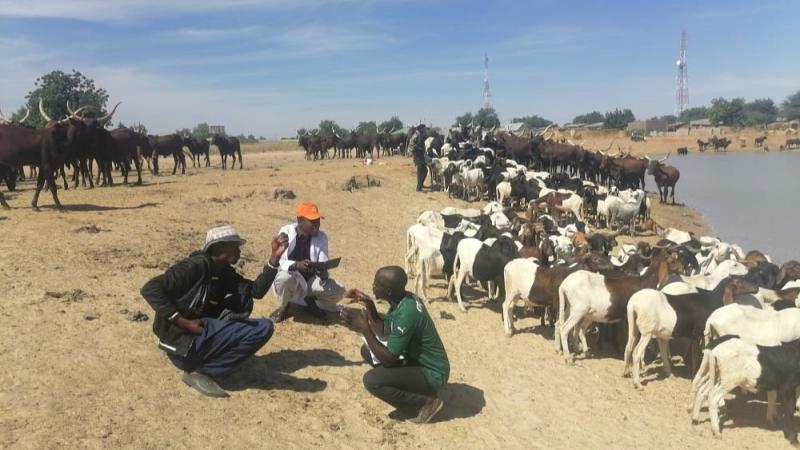
The result is a tool that gives farmers and local vets something they’ve rarely had before: clear, personalised information about the economic impact of disease and the tangible value of vaccination.
The app’s potential was clearly demonstrated in the recently published study, which highlights both the urgency of such tools and their transformative impact when placed directly into the hands of end-users.
A tool shaped by the realities of the field
Economic models are often inaccessible - they rely on computers, stable internet, and technical training. For many smallholder farmers, even navigating a spreadsheet isn’t always realistic. The app offers something different:
- Real-time outputs, generated on a mobile phone
- Minimal data entry, framed as simple, intuitive questions
- Results displayed visually, through graphics farmers can interpret instantly
By stripping away unnecessary complexity without compromising scientific accuracy, the team created a bridge between academic modelling and day-to-day decision-making on farms.
“We had to simplify the models, but not to the point where they stopped being useful,” Dr Rawlins recalls. “And we had to write questions that everyone understood the same way, regardless of background.”
The core strength of the app lies in its ability to deliver farm-specific estimates - tailored insights that reflect each farmer’s herd, prices, and disease experience.
This matters, as Dr Adeyinka explains:
“What benefits one farmer might not benefit another. The app helps them make informed decisions based on their own situation, in real time. We also hope the app will improve vaccine uptake among livestock farmers in Nigeria.”
Through the app, farmers and vets can see the economic cost of a recent or ongoing outbreak, how much income was lost to reduced sale prices, the potential financial benefit of vaccinating, and how different subsidy levels change the equation.
Putting the App to the Test
The NVRI team tested the app with 291 farmers across five northern states, along with gathering real outbreak data and observing how farmers interacted with the tool.
The feedback was encouraging. Farmers described the app as useful, intuitive, and easy to understand - a significant achievement given the technical concepts it conveys. The visual outputs were valued, with several farmers saying that income‑comparison charts (with and without vaccination) made the information much easier to interpret.
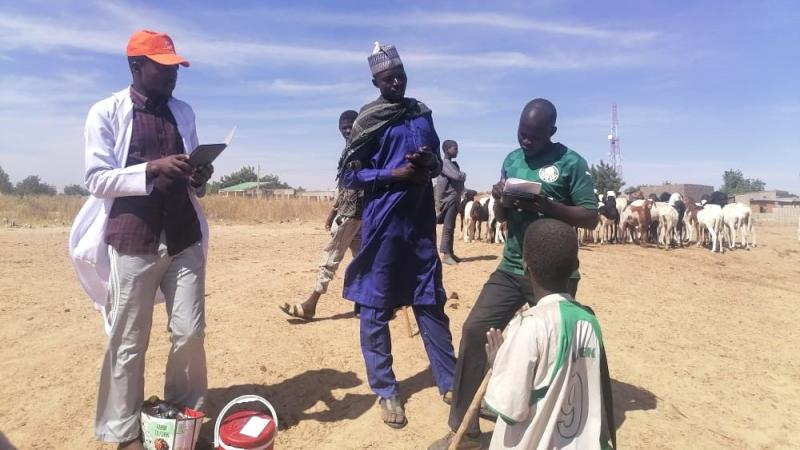
The team, however, also encountered several barriers during testing. Some farmers were still wary of using technology, while others did not have access to smartphones at all. Even among those who did, levels of digital literacy varied widely. Despite this, the appetite for information was clear. Many farmers reported that using the app made them more likely to vaccinate - a promising, though still qualitative, indication of behavioural change.
Though the underlying model focuses on sheep pox and goat pox, the current version was adapted to cover other small ruminant infectious diseases.
“Whether we expand depends on interest,” Dr Limon-Vega notes, “but the structure is there to go much further.”
A step toward equitable decision-making
The app recognises that good disease control starts with good information, and that farmers - especially those working in challenging or resource-limited settings - deserve tools designed specifically for their realities.
It is an example of research that moves beyond publication and into the hands of the people who need it most.
As the published study highlights, it also fills a crucial data gap: real-time, standardised economic and epidemiological data that can support national policy decisions and strengthen future vaccination strategies.
For Dr Limon-Vega and the team, the work is far from over. But already, the app is doing something meaningful: helping farmers see the true cost of disease - and the value of prevention - in a way that’s clear, accessible, and actionable.
Interested in trying the app?
Fill in this form and click submit to instantly access the download link and instructions.