


A scientist at The Pirbright Institute who contributed to a recent breakthrough in poxvirus research says the findings open new avenues for research. They could help scientists investigate how poxviruses establish infection after entering a cell and how that process can be blocked.
Miguel Hernandez Gonzalez and co-workers have uncovered the structure of the poxvirus ‘portal complex,’ a channel in the viral core wall that allows the virus to release genetic material after entering a cell. In a study published in Nature, Miguel, working in Michael Way's laboratory at the Francis Crick Institute, and in collaboration with Tom Calcraft in Peter Rosenthal’s lab, used cutting-edge cryo-electron tomography to reveal the architecture of the complex.
By combining high-resolution images with protein predictions, the team identified three essential viral proteins that form the portal - a discovery that advances scientists' understanding of how poxviruses begin infection.
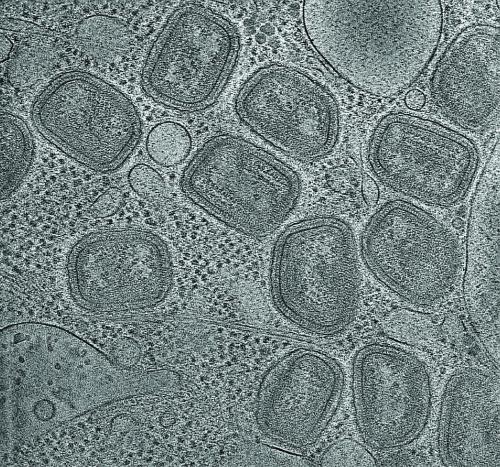
Electron cryotomography image of a cell infected by vaccinia virus
"We identified three crucial proteins that make up the portal complex," Miguel explains. "They're all previously known to be essential for mRNA export and one is also involved in the assembly of new virus particles, showing how critical portal complexes are to the virus."
Miguel, who now leads Pirbright’s Large DNA Virus Assembly group, is continuing research into the biology of the portal complex. “Although we have now described this important portal complex, we now need a deeper understanding of how it works. We also propose that the portal complex is a promising broad-spectrum antiviral target against all poxviruses," says Miguel.
Miguel has recently secured a Rosetrees Continuation Award to extend this line of research. The grant brings together expertise from across the UK, with Peter Rosenthal collaborating on structural biology, Carlos Maluquer de Motes from the University of Surrey providing additional poxvirus expertise and Trevor Sweeney at The Pirbright Institute contributing specialist knowledge in nucleic acid biology.
The findings suggest that the portal complex acts as a central hub that coordinates key stages of the virus replication cycle, providing researchers with a potential new target for antiviral drugs.
Through the Rosetrees Award, his team will build on these findings to further investigate the portal complex during infection. The findings may also have implications for future antiviral research.
The Pirbright Institute provides an ideal setting. Alongside world-leading expertise in virology and access to Trevor Sweeney's nucleic acid biology expertise, Pirbright offers unique high-containment laboratories capable of safely studying highly pathogenic poxviruses, including lumpy skin disease virus - facilities unavailable anywhere else in the UK.
Support from The Pirbright Institute will allow Miguel's team to extend these findings across the wider poxvirus family, including viruses that threaten both animal and human health. Because genetic and structural evidence suggests the portal is highly conserved, discoveries made in one virus could have broad implications across many others, including emerging pathogens such as mpox.
“Ultimately, we want to understand one of the most fundamental steps in poxvirus infection,” said Miguel. “By revealing how viruses release their genetic material into cells, we can identify vulnerabilities in that process. That knowledge will provide a foundation for developing new strategies to control poxvirus infections in both humans and animals.”
For further information on Pirbright’s Large DNA Virus Assembly work, click here.