


Researchers at The Pirbright Institute have uncovered a molecular trick used by the deadly African swine fever virus (ASFV) to silence the host antiviral response.
A study published in npj Viruses (2026) reveals how a protein produced by ASFV exploits the host cell's own protein degradation machinery to target the early response to viral infection.
ASFV is a large, complex DNA virus that causes a haemorrhagic disease with lethality rates approaching 100%. Despite the catastrophic economic and food security impacts the disease has inflicted across Europe, Asia and Africa in recent years, its mechanisms of virulence remain poorly understood, and licensed vaccines are only available in a handful of countries. The new study, led by Dr Ana Reis and Dr Samuel Connell, focused on a cluster of viral proteins known as multigene family (MGF)505. Loss of members of these multigene families is commonly observed in naturally occurring attenuated virus strains, indicating that they play an important role in disease pathogenesis.
The team discovered that MGF505-1R contains a structural feature called a SOCS-box motif. SOCS-box motifs are typically used by cellular proteins to recruit the Cullin-RING ligase (CRL) machinery, a superfamily of E3 ubiquitin ligases that target proteins for proteasomal degradation. In effect, the virus borrows the cell's internal "waste and recycling centre" and repurposes it to dispose of the host's own immune components.
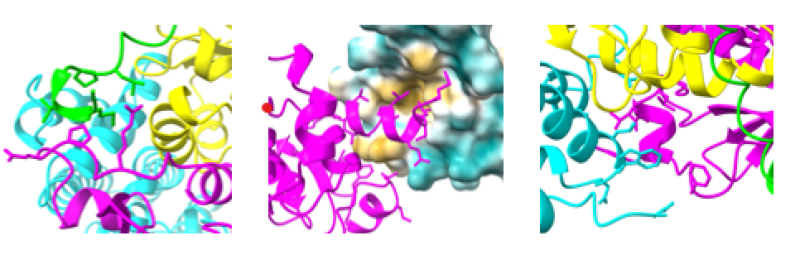
CRL machinery complex showing EloC (yellow), EloB (green) and Cul5 (cyan)
The data show that MGF505-1R inhibits the host innate immune responses controlled by the activation of the transcription factors IRF3 and NFκB, which play a central role in alerting cells to viral infection. Crucially, the viral protein does not block these transcription factors from entering the cell nucleus. Instead, it appears to act downstream at the level of the gene promoters themselves. The trail led to p300, a protein that acts as a transcriptional co-activator required to switch on the expression of many immune-related genes. MGF505-1R expression was shown to correlate with reduced levels of the p300 protein. Strikingly, when researchers mutated the viral SOCS-box motif, suppression of both immune pathways was reversed.
Dr Reis, Institute Fellow in ASFV at The Pirbright Institute, said:
"Our study reveals, in molecular detail, how ASFV exploits the host's own protein degradation machinery to undermine the earliest stages of the immune response. The work by Glassman and colleagues highlighted the remarkable extent to which viruses across the virosphere have evolved to co-opt ubiquitin pathways. The Pirbright work provides exactly the kind of mechanistic depth that complements that panoramic view by showing precisely how an ASFV virulence factor recruits the host machinery to disable key immune functions. Understanding these virus-host interactions is essential for developing more effective vaccines and control strategies against this devastating disease."
The finding gains broader significance in light of the work of Glassman et al. (Science, 2026), in which a virome library of approximately 10,000 open reading frames was used to systematically identify viral ubiquitin ligases across the viral world, mapping their mechanisms of degradation and host substrates. This broad analysis identified not only MGF505 proteins but also members of the ASFV MGF360 family as canonical ligases that mimic host protein motifs to recruit the CRL machinery.
Importantly, Glassman and colleagues observed a striking convergence towards immune-related host targets across diverse viral families, highlighting immune evasion as a major driver in the evolution of viral ubiquitin ligases.The ASFV MGF505-1R protein fits squarely within that landscape and provides further evidence that ASFV has evolved multiple complementary strategies to manipulate host ubiquitin signalling and suppress antiviral defences.
The research was funded by UK Research and Innovation (UKRI) and the Biotechnology and Biological Sciences Research Council (BBSRC) through an iCASE award under the Oxford Interdisciplinary Bioscience Doctoral Training Partnership, reflecting the UK's continued investment in understanding and combating economically devastating animal diseases.
Read the paper: The African swine fever virus MGF505-1R protein recruits the cullin-RING-ligase machinery to promote p300 degradation.